Context
My research is concerned with the visual manifestation of memory on paper. I have found that when attempting to retrieve my own memories, I am rarely able to access a clear image of a specific event or scene. Instead, memory appears fragmented, filtered, and increasingly blurred over time. Certain memories intensify, while others are altered or distorted. This instability of memory forms the conceptual foundation of my practice.
I have long been interested in the material instability of Polaroid photography, particularly its sensitivity to temperature, humidity, and environmental conditions, which can significantly alter image outcomes. My interest was shaped by the work of Lucas Samaras, who manipulated Polaroid prints during development by squeezing, scratching, and damaging the image surface. Observing his work led me to recognize the fundamental irreversibility of such processes: once an action has occurred, the image cannot return to its previous state. Even when similar procedures are repeated, results can never be fully replicated. This characteristic resonated with my understanding of memory as something that, once experienced, cannot be restored to its original condition.
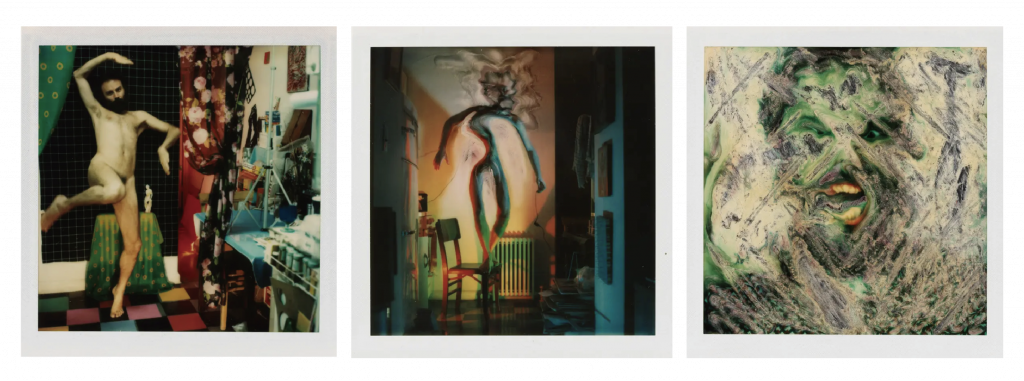
Due to the high cost of sustained Polaroid experimentation without equipment sponsorship, I began to search for alternative methods that could retain this sense of irreversibility and variability while remaining materially accessible.
I was also influenced by the work of Rosie Clements, who prints images onto bubble wrap, producing blurred and distorted visuals that closely resonate with my investigation into memory. Unfortunately, the earliest available UV printing slot I could book was scheduled after the end of the project. As a result, I attempted to approximate this method by using adhesive-based image transfer processes as an alternative approach.
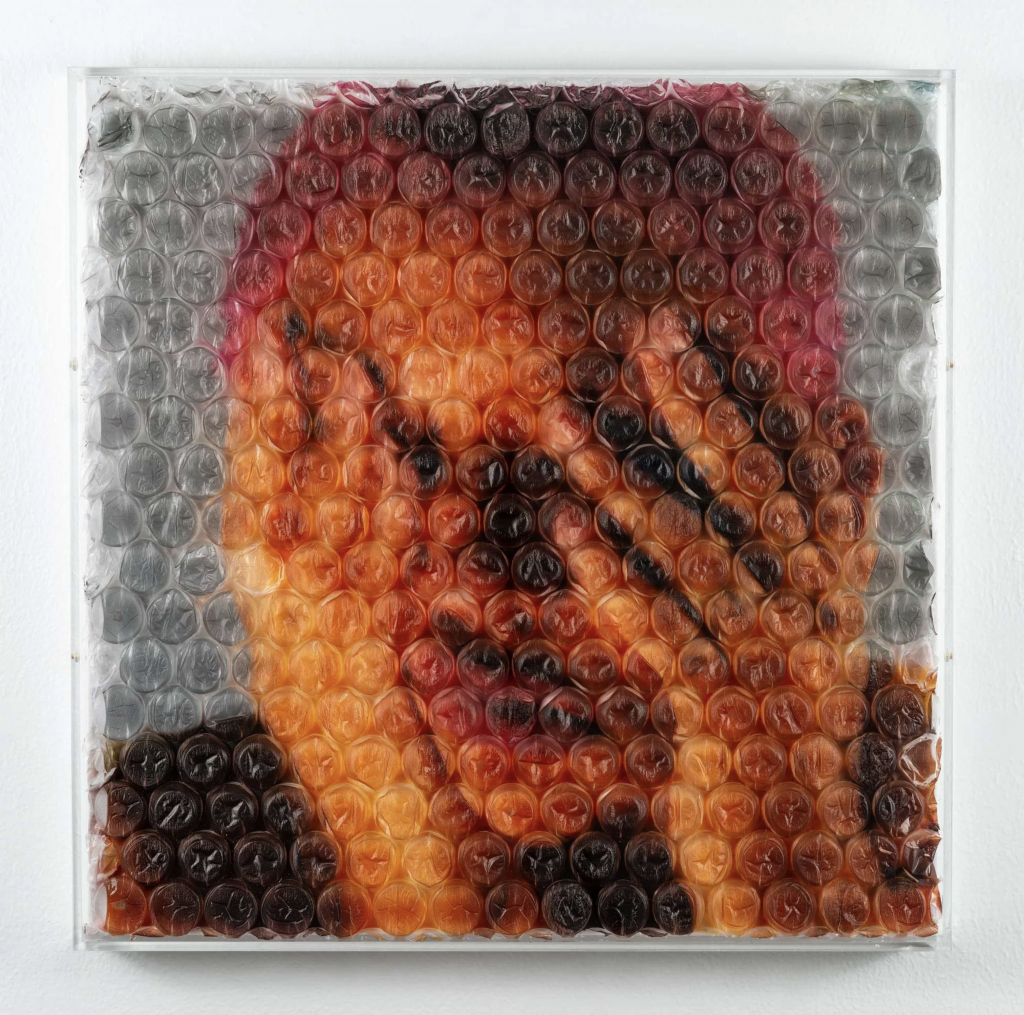
So I initially experimented with transferring laser-printed images onto a range of textile materials using adhesive, including bubble wrap, medical gauze, cheesecloth, stretch mesh fabric, and industrial cleaning cloth. While these experiments produced visually engaging results, the range of possible interventions remained limited.
Process
In seeking alternative approaches, I encountered the work of John Fobe, who employs camera-less photographic processes by placing plants directly onto photosensitive paper and exposing them to sunlight. His work prompted me to think of memory as something that emerges vaguely—like a blurred image appearing momentarily before dissolving again.
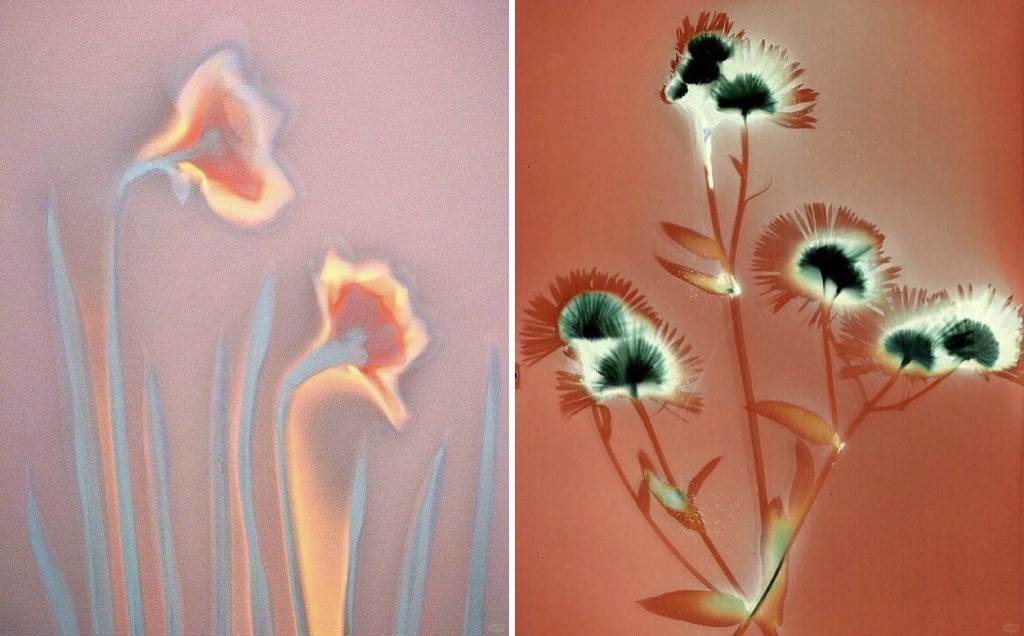
I began collecting fallen plants from nearby parks and arranging them on photosensitive paper in a darkened environment. The plants were fixed between two transparent acrylic sheets using clamps and then exposed outdoors on a balcony. Due to insufficient daylight on an overcast day, I later continued exposure indoors using artificial light. After approximately five hours, I obtained images with rich tonal layers and halo-like effects. Following standard instructions, I placed the most successful image into the developer, which resulted in a completely black image.
After researching potential causes, I initially assumed the failure was due to an incorrect developer ratio. The following day, I attempted to recreate the image, but the flower materials had almost entirely withered overnight. Despite recreating nearly identical conditions, the image could not be recovered. Time had already removed the possibility of repetition, leaving only a vague mental trace of the previous day’s result. Although I gradually identified patterns related to humidity, translucency, and exposure duration, I was still unable to successfully develop the image. This led me to book an induction session at the photography darkroom to further investigate the issue.
During the darkroom induction, I realized that photographic development itself contains significant creative potential. Variations in timing, partial exposure, or the deliberate omission of certain steps could each produce dramatically different results. When I asked a technician why my photosensitive paper had turned completely black, she explained that this process did not require chemical development at all. Previously, although I had used film cameras, I had assumed photographic development to be linear and deterministic. This experience revealed the extent to which chance and contingency are embedded within the process.
Following this, I began experimenting with materials of varying pH values. Initial tests using household substances such as lemon juice, coffee grounds, vinegar, oil, alcohol, and detergent produced primarily pink and brown tones. Further research revealed that these substances were insufficiently reactive. I then introduced stronger cleaning agents, such as sodium bicarbonate and hydrogen peroxide, combined with diluted film-processing chemicals. Applying these materials directly onto photosensitive paper, I approached the process in a manner similar to painting. Over time, unexpected textures and colors emerged, producing images that could not be replicated, even when all materials and steps were carefully recorded.
Reflection
My practice approaches memory not as a fixed narrative to be reconstructed, but as a process that is continually rewritten through repetition, condition, and material interaction. This position aligns with the experimental logic of Exercises in Style by Raymond Queneau, in which the same event is repeatedly retold through different formal constraints. In Queneau’s work, repetition does not stabilize meaning but instead exposes its instability. Similarly, repeated engagement with memory does not produce greater clarity; rather, it generates divergence and transformation.
This understanding is further supported by principles articulated in the Conditional Design framework, which emphasizes the role of conditions, systems, and processes over predetermined outcomes. Within my practice, I establish variables such as time, precision, repetition, and material interaction, allowing images to emerge through these constraints rather than through authorial control.
Together with the irreversible manipulations present in Samaras’s work, these references inform a methodology in which the designer functions not as the sole author of meaning, but as the initiator of conditions. Through abstraction, improvisational assemblage, and non-linear processes, photosensitive paper—normally governed by strict darkroom protocols—is intentionally removed from its regulated framework. As materials react and fade over time, the images undergo a process akin to re-exposure, mirroring the temporal instability of memory itself. The resulting works operate as de-authorized surfaces, open to interpretation and capable of supporting multiple readings rather than a singular subjective narrative.
Reference
1. Samaras, L. (2003) Lucas Samaras: Photo-Transformations. New York: Pace Gallery.
2. Clements, R. (n.d.) Selected works. Available at: https://www.instagram.com/_rosieclements/
2. Fobe, J. (2016) Cameraless Photography and Light Experiments. Berlin: self-published.
3. Queneau, R. (1998) Exercises in Style. Translated by B. Wright. Boston: David R. Godine. (Original work published 1947).
Leave a Reply