For this project written response, I chose the following paragraph from Introduction: Bringing Feminist Theory Home by Sara Ahmed, using the way of inventory to analyze it.
“As I show in part II, my own experience of bringing up racism and sexism within the academy ( of refusing to bracket these questions in a more loving digestion of the philosophical canon) replicated some of my earlier experiences of bringing up racism and sexism at the family table. This replication is another form of pedagogy: we learn from how the same things keep coming up. You are assumed to be interrupting a happy occasion with the sensation of your own negation. You are assumed to be doing identity politics as if you speak about racism because you are a person of color or as if you speak about sexism because you are a woman. Nirmal Puwar (2004) has shown how some become “space invaders” when they enter spaces that are not intended for them. We can be space invaders in the academy; we can be space invaders in theory, too, just by referring to the wrong texts or by asking the wrong questions. A question can be out of place: words too.
One response might be to aim to reside as well as we can in the spaces that are not intended for us. We might even identify with the universality of the university by agreeing to put our particulars to one side.5 There is disruption, even invention, in that, of that I have no doubt. But think of this: those of us who Feminist Theory HomeI arrive in an academy that was not shaped by or for us bring knowledges, as well as worlds, that otherwise would not be here. Think of this: how we learn about worlds when they do not accommodate us. Think of the kinds of experiences you have when you are not expected to be here. These experiences are a resource to generate knowledge. To bring feminist theory home is to make feminism work in the places we live, the places we work. When we think of feminist theory as homework, the university too becomes something we work on as well as at. We use our particulars to challenge the universal.” (351 words)
Inventory
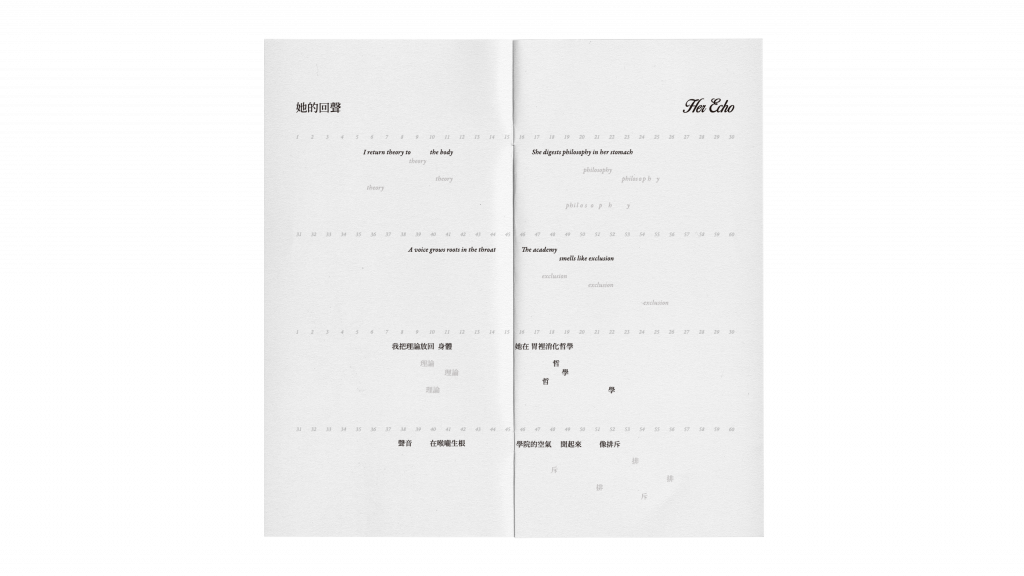
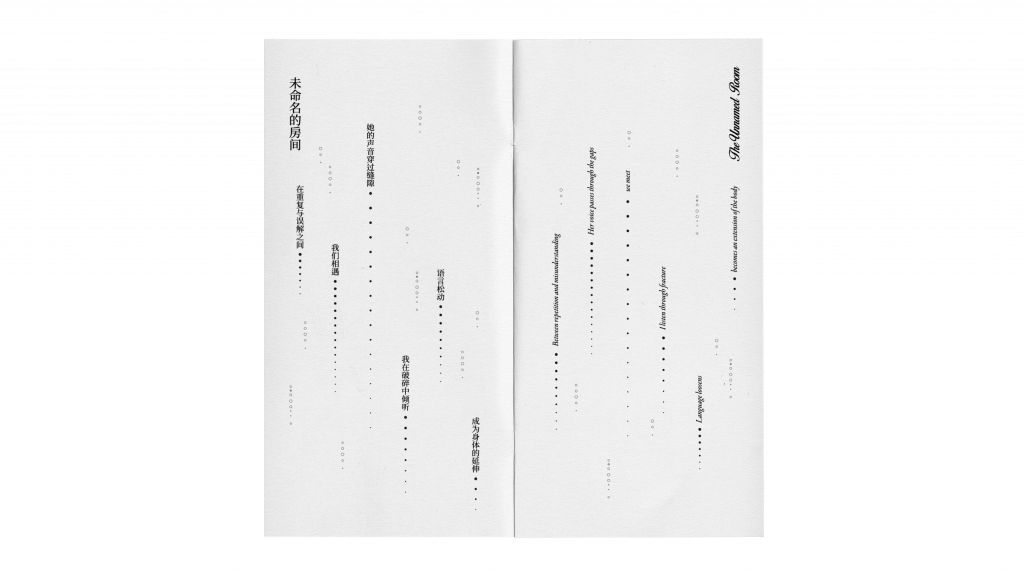
In this project, I examine how women’s emotions are often misread, romanticized, or signified as objects of the male gaze in a language syntagmatically structured by social organization and patriarchal grammar. Through algorithmic reconstruction, I hope to build a new feminine syntax: a mechanism of expression that ceaselessly deflects, slips away, and recombines.
The procedure commences with the creation of a semantic re-coding archive based on pamphlet titles in the Harvard Library’s digital collection, What Women Want to Know. The titles were structured and transformed into ascertainable linguistic material. Thereafter, poems I had constructed as a woman, texts interested in female desire, intimacy, and modification of attitude towards relationships, were examined by means of which structural templates were constructed. Finally, poems were constructed by means of Python and randomized imagery substitution and recombination.
In the visual presentation of the poetry collection, I randomly selected complete pamphlet titles, preserved their original typography, and integrated them with newly generated poems. The 34 poems each take a different visual form, mirroring the poem’s emotional or linguistic context. The notes, like a montage, contrast prescriptive, disciplinary titles with algorithmically generated poems, where the illusion of teaching suggests the reaffirmation of female subjectivity.
The dual presentation in Chinese and English is intentional. The poems were originally written within a Chinese linguistic and emotional framework, but translation into English introduces new shifts in tone and meaning. This bilingual layout visualizes the difference between two cultural grammars and ensures accessibility for non-Chinese readers.
For the accompanying reading material, I used the same methodology—extracting and re-categorizing key words, analyzing poetic syntax, and generating new texts from a personal feminist perspective—as both a critical and creative response to the project’s theoretical foundation.

Reference list
1. Ahmed, S. (2017). Living a feminist life. Durham: Duke University Press.
2. Curiosity Collections. (n.d.). What Women Want to Know. [online] Available at: https://curiosity.lib.harvard.edu/what-women-want-to-know/catalog?search_field=all_fields.